
Two strong answers to the same modernization question — different architecture philosophy, operating model and audience. A neutral comparison across the dimensions that actually decide it.
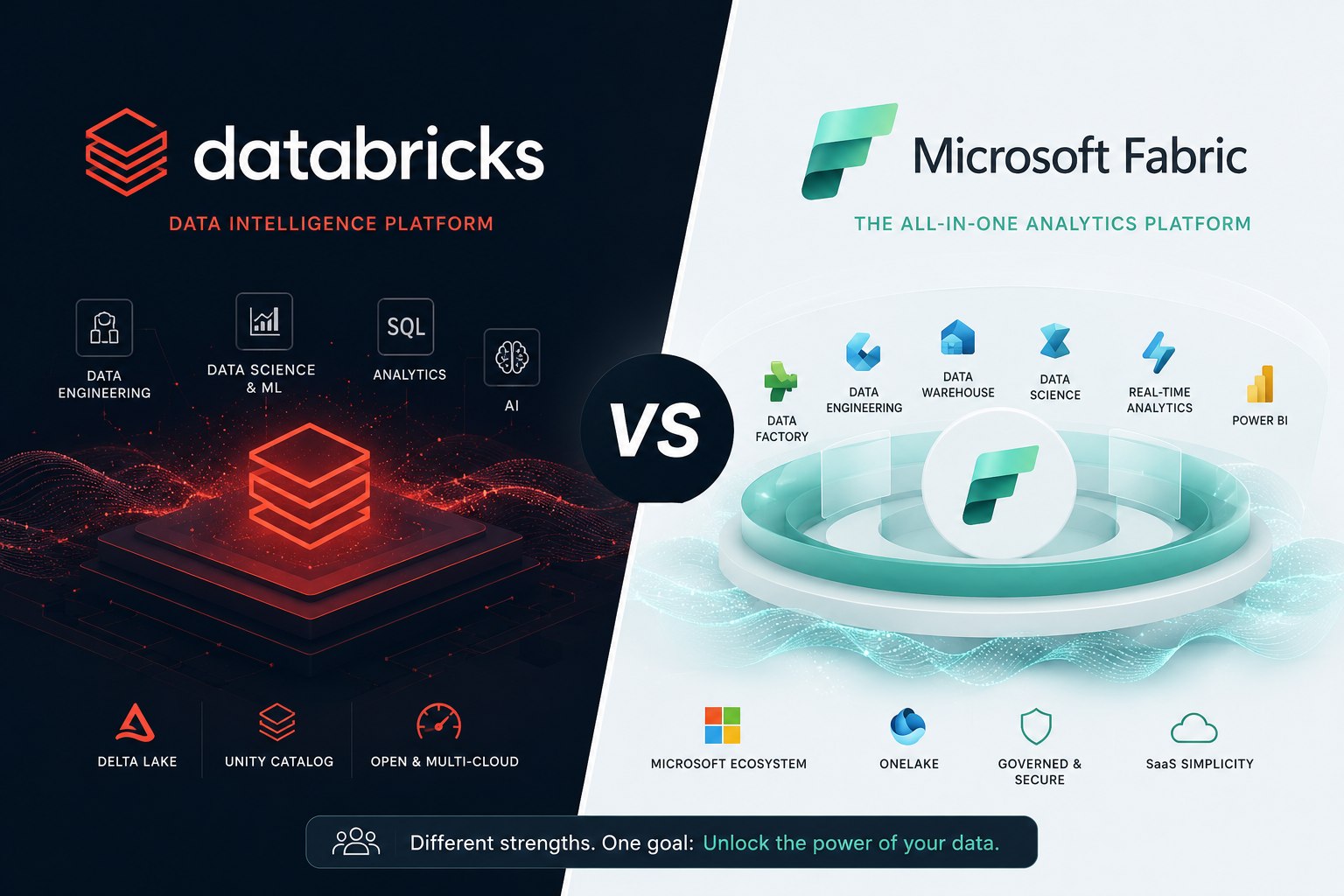
As organizations modernize their data platforms, two solutions are frequently evaluated: Microsoft Fabric and Databricks. Both support advanced analytics, AI and large-scale data processing. While they overlap in many capabilities, they differ in architecture philosophy, operating model and target audience.
This article is a neutral, high-level comparison across the dimensions that actually decide the choice — a starting point for deeper discussion, not a definitive technical evaluation.
| Databricks | Microsoft Fabric | |
|---|---|---|
| Philosophy | Engineering-driven lakehouse platform | Unified SaaS analytics platform |
| Sweet spot | Large-scale engineering, streaming, ML — plus SQL analytics via Databricks SQL | Integrated analytics and BI in one environment, native Power BI |
| Skills | Large certified engineering pool, strong Spark ecosystem | Accessible to SQL / Azure / Power BI backgrounds, fast onboarding |
| Pricing | Consumption-based — granular optimization, needs active tuning | Capacity-based — predictable budgeting, needs capacity planning |
| AI | Databricks Assistant & Genie — flexibility and customization | Copilot across workloads — broad accessibility |
| Governance | Unity Catalog — fine-grained, multi-environment | Unified with the Microsoft ecosystem, one SaaS security model |
| CI/CD | Established patterns, strong Git and automation | Rapidly evolving, simpler for analytics teams |
Neither column wins on capability alone — the choice follows architecture preference, team structure and ecosystem alignment. The detail behind each row is below.
Open a dimension for the detail — the same neutral comparison, row by row.
Both platforms support lakehouse and warehouse patterns — they approach them differently.
Built around the lakehouse concept, widely adopted for:
Not limited to engineering: Databricks SQL adds a high-performance SQL analytics layer. For BI it is frequently combined with Power BI — Databricks as the governed lakehouse and SQL engine, Power BI for semantic modeling and reporting.
A unified, SaaS-based analytics platform integrating:
Because the components are tightly integrated in a single environment, Fabric can reduce architectural complexity and simplify operational management.
In practice. Databricks is often chosen for engineering-driven, scalable lakehouse architectures that also carry warehouse workloads via Databricks SQL; Fabric for organizations seeking an integrated analytics and BI experience in one SaaS platform. Both support modern warehouse and lakehouse patterns — the choice usually comes down to architecture preference and team structure, not capability gaps.
Today, Databricks skills are generally more widespread in engineering-heavy environments. Fabric adoption is accelerating, particularly within Microsoft-centric enterprises.
Neither platform is inherently more cost-effective. Architecture, data volumes, concurrency patterns and governance discipline have greater impact than the pricing model alone.
Advanced support for AI and ML workloads, including:
Particularly valuable in data-engineering and data-science-oriented environments.
AI features integrated across workloads, with Copilot experiences designed to:
Fabric emphasizes broad accessibility of AI; Databricks emphasizes flexibility and advanced customization.
Both platforms offer enterprise-grade governance. The choice often follows existing ecosystem alignment and organizational complexity rather than feature limitations.
Organizations with a strong DevOps culture often appreciate Databricks' flexibility; Fabric can streamline development for integrated analytics teams.
Choose on use cases, team skills and ecosystem alignment — then hold either platform to the same standard of governance and delivery.
Choosing between Microsoft Fabric and Databricks is rarely a purely technical decision — it depends on business objectives, team skills, governance requirements, existing investments and long-term AI strategy. We support organizations by:
Our approach is platform-agnostic and focused on building sustainable, business-driven data platforms.
Whatever is on your mind — a plan, a question, a challenge — we're happy to think it through with you.
Get in Touch ← All posts